About 2 months ago we were at HT, our favorite Chinese market, and I had just picked up a pound of frozen smelt. Elyse said simply "what are you going to do with those?" although the tone in her voice was more like "Dude, aside from this package of frozen catfish heads, you just picked up the grossest looking thing in here." Several months earlier I had seen a recipe in Chez Jacques that I was determined to cook if I could ever find Whitebait. I did remember Jacques mentioning that if you can't catch your own you will probably find them at a Chinese market, but these were labelled smelt. I bought them anyway, figuring they would fry up just fine.
Whitebait, as I later learned, is also called smelt and is usually immature Herring, but the word refers to different immature fish in different parts of the world. I had wondered if these whitebait were what I knew as minnows as a kid, but it turns out that minnows are fish that grow up to be small, whereas Whitebait are fish that are still growing up.
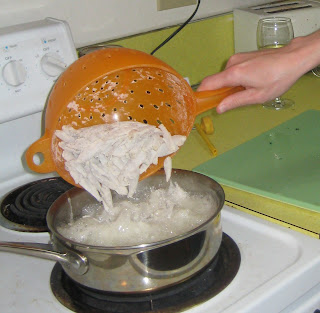
 So, now we bread the fish with the flour. First you pat the fish dry with paper towels, they should be pretty dry because we don't want any extra water in that hot oil. Jacques says to dissolve a tablespoon or so of flour into a cup of milk because it'll thicken the milk. Add some freshly ground pepper. Dump the fish into the milk mixture. Make sure they are coated. Then put a cup of flour into a 1-gallon bag, and take the fish out of the milk, and drop them into the bag. Close the bag and pretend you have Shake n 'Bake. Dump the fish into a colander and shake off all the excess flour.
OK, cook the fish at least 3 minutes - stirring occasionally - until they are a beautiful golden brown. As you know, the color is a more important indicator than the timing. Take them out with a skimmer or a slotted spoon. Lightly sprinkle some salt on them. Jacques likens them to french fries! Eat them immediately. They would be especially good on a hot summer evening with friends (this recipe will serve 4-6) and a crisp white wine.
The ones I got were headless, and already cleaned, and about 2 inches long. I was disappointed that they were headless, I wanted to eat the head! The head makes the dish all the more hardcore, still hardcore-for-beginners, though, not like eating bone marrow, or intestines, or simmering a chicken in its own blood. Yum! If yours aren't cleaned you will need to squeeze their guts out of their poop hole. This is called dead-pooping your guts out. Squeeze out the parts that are easy to remove, and don't worry if you leave some guts behind.
Lets talk about flour. Flour is an odd one because it tastes real bad when its uncooked, but real good when cooked. If you use flour to thicken a sauce but then fail to cook the sauce adequately, for example, your sauce will be pasty-tasting. If you don't believe me go shove a handful of raw flour in your mouth. You know you don't want to! Its totally bad! Now we are going to coat the fish with it! And its bad! But something happens when you cook it, it turns a tasty fish into a delectable little fish-french-fry. You get, like, notes of bread with the fish. No one ever refers to this flavor as 'notes of bread' or 'hints of bread' but that's what it is.
By the way, if 'notes of bread' doesn't sound brilliant to you then you need to be eating some better bread.
By the way, if ANY food doesn't sound brilliant to you, then are eating a bad version of it. Every member of our species likes mushrooms, liver, and even the occasional beet if is fresh and prepared properly.
 So, now we bread the fish with the flour. First you pat the fish dry with paper towels, they should be pretty dry because we don't want any extra water in that hot oil. Jacques says to dissolve a tablespoon or so of flour into a cup of milk because it'll thicken the milk. Add some freshly ground pepper. Dump the fish into the milk mixture. Make sure they are coated. Then put a cup of flour into a 1-gallon bag, and take the fish out of the milk, and drop them into the bag. Close the bag and pretend you have Shake n 'Bake. Dump the fish into a colander and shake off all the excess flour.
Now we will deep fry. You only need to know a few things about deep frying, and you really need a digital thermometer for this. They are cheap, and extremely useful, I bought a Taylor model #9842 from Amazon for about $15 and I use almost every time I cook. There are 2 very important things to know about temperature,
1) Keep the oil below 400F, or it will burn, and your food will taste burnt.
2) Keep the oil above 300F or your food will absorb a lot of oil.The 2nd rule is the surprising one, I think. If you keep the temperature high enough you won't end up with an oil-bomb of a dish. According to Hervé This in Molecular Gastronomy, the process of deep frying is the process of steaming food from the inside. As the water boils it leaves as steam, and if the steam pressure is high enough the oil doesn't seep in. He goes on to say that if you can wipe the oil off the food immediately after frying if you want to prevent that outer layer of oil from soaking in.
In order to help you control the temperature you should use a lot of oil and a heavy saucepan. I used 1.0 quart of oil, but even 1.5 qts would have been a big improvement. The heavy saucepan will prevent the temperature from falling when you drop the fish in. I recommend a 4-quart saucepan or so, because the fish really fill it up, and you so-don't wanna spill.
In order to help you control the temperature you should use a lot of oil and a heavy saucepan. I used 1.0 quart of oil, but even 1.5 qts would have been a big improvement. The heavy saucepan will prevent the temperature from falling when you drop the fish in. I recommend a 4-quart saucepan or so, because the fish really fill it up, and you so-don't wanna spill.

Now heat your oil to 360F, and carefully slide the fish in. It'll bubble like mad for the first minute, but then die down. While that happens lets talk about how to learn to cook. Its easy! Most of the things I'm telling you here I figured out as I went. This was the first time I had ever deep fried, though, and I made some mistakes. I used a sauté pan that was too small to do this task safely (2-1/2 qts), and it was too thin to keep the temperature up. After I dumped the fish in the temp fell to 280F and I had to turn the heat on the stove all the way up to keep it from falling any further! And they still tasted great! So if you don't have the "proper equipment" you can still make this dish, but I strongly recommend the thermometer, and a bigger saucepan than I used.
OK, cook the fish at least 3 minutes - stirring occasionally - until they are a beautiful golden brown. As you know, the color is a more important indicator than the timing. Take them out with a skimmer or a slotted spoon. Lightly sprinkle some salt on them. Jacques likens them to french fries! Eat them immediately. They would be especially good on a hot summer evening with friends (this recipe will serve 4-6) and a crisp white wine.
Happily, Elyse was blown away, her initial skepticism went out the door the instant she saw me dump 50 little fish into a bowl of milk. I made this about a month ago, in fact, long before we ever decided to blog, and she pulled out her camera and started documenting my activities. Unfortunately we were too busy eating them to remember to take any pictures of the finished product!


